

STATE TIMES NEWS
JAMMU: Sher-e-Kashmir University of Agricultural Sciences & Technology of Jammu (SKUAST-J) has entered a significant global partnership by signing a Memorandum of Understanding (MoU) with Kangwon National University (KNU), Chuncheon, South Korea.
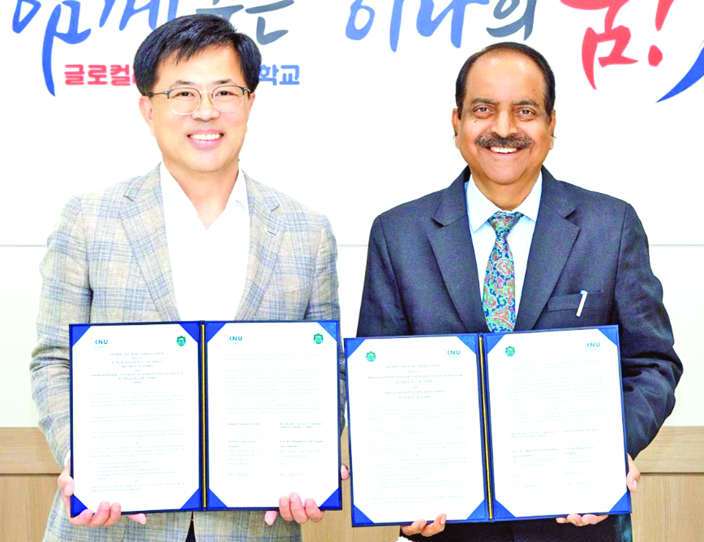
The MoU was signed by Prof. (Dr.) B.N. Tripathi, Vice Chancellor, SKUAST-Jammu, and Prof. Jeong Jaeyeon, President of KNU, to promote academic exchanges, joint research, and student-faculty exchange programs.
Present at the ceremony were Prof. Sung-Jin Lee, Dean of College of Animal Life Sciences, and Prof. Junghoon Choi, Dean of College of Veterinary Medicine from KNU, along with Prof. Neelesh Sharma from SKUAST-Jammu. KNU, established in 1947, is South Korea’s largest university with over 31,500 students, 1,950 faculty members, 18 colleges, and 55 research institutes, hosting more than 2,000 international students globally.
Prof. Tripathi emphasized that the MoU is a transformative step towards the internationalization of agricultural education and research in Jammu and Kashmir. He underlined the importance of global exposure for students and faculty, especially in tackling shared challenges like food security and climate change. He also highlighted the achievements of SKUAST-Jammu and advocated for international internships for students in veterinary, agriculture, horticulture, and biotechnology disciplines.
During the visit, Prof. Tripathi toured KNU’s colleges and departments, meeting with deans to explore collaborative research opportunities. He also delivered a keynote address at the International Symposium on “Innovations and Recent Developments in Animal Health and Production” organized by KNU.
Prof. Jeong expressed strong interest in the collaboration, noting its potential to enhance research in diverse agro-climatic zones and strengthen cultural ties. This MoU is aligned with national education policies and is expected to enhance the global relevance of agricultural education in the region while boosting research, innovation, and local agri-economic development.
