
PM Modi’s leadership reduced emotional, geographical distance between J&K and Delhi: LG

STATE TIMES NEWS
SRINAGAR: Lieutenant Governor Manoj Sinha has credited Prime Minister Narendra Modi’s leadership for reducing the emotional and geographical distance between Jammu and Kashmir and Delhi, fostering a stronger sense of unity.
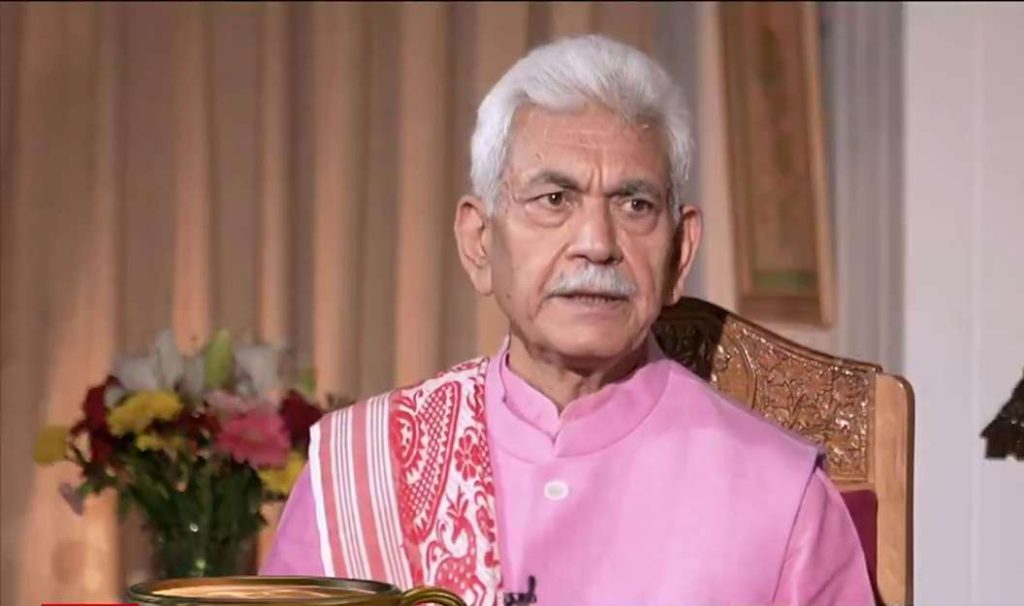
In an exclusive interview to a national news channel (ABP), the LG candidly reflected on the accomplishments, challenges, and the evolving socio-economic landscape of this strategically significant union territory.
“When I assumed office, Jammu and Kashmir was still grappling with the shadows of unrest, frequent shutdowns, and strikes instigated by hostile elements from across the border. Today, the scenario is strikingly different. There was a time when, at the behest of our neighboring country, this region would shut down due to strikes. That is now a thing of the past,” Sinha said, emphasizing a palpable shift toward stability.
“One of the most telling signs of this change has been the absence of stone-pelting incidents, a common form of protest that marred public order for decades. For the first time in over 30 years, peaceful Muharram processions have taken place uninterrupted, symbolizing renewed communal harmony and mutual respect”, he said adding that normal life has resumed with vigour.
“Cinema halls have reopened, educational institutions including schools and colleges operate without disruption, businesses flourish, and nightlife has begun to revive. Because of all this, the common man’s trust has grown significantly,” Sinha noted.
On the economic front, the LG’s tenure has been marked by significant growth and structural reforms.
“In five years, we have doubled the economy of Jammu and Kashmir,” he proudly declared. A remarkable turnaround was witnessed in the banking sector, with J&K Bank transitioning from a loss of Rs 1300 crore to a profit of Rs 1700 crore, now ranked among the country’s best banks. This recovery has directly alleviated financial stress for the local population.
Tourism, a vital pillar of the region’s economy, has surged dramatically. Last year alone, approximately 2.38 crore tourists-both domestic and international-visited Jammu and Kashmir. The Pahalgam attack, which sent ripples of fear through the hospitality industry, was quickly overshadowed by rapid recovery and investment.
“Someone who had just one hotel in Pahalgam now owns at least one more; many have built two or three hotels. Over 5000 new hotels have been constructed in the Kashmir Valley,” Sinha said
Agriculture, which supports nearly 70% of the population, has also seen a transformative push under a Holistic Agriculture Development Plan launched in 2022, he said, adding that developed in consultation with agricultural experts and universities, the plan focuses on 29 projects aimed at doubling the sector’s economic contribution.
The results are promising-local fodder production has doubled from 40% to 80%, and the region has moved from a milk deficit to surplus. The rise of agri-entrepreneurs, including graduates from engineering and management backgrounds, indicates a diversification of rural employment and income sources, Sinha said.
Infrastructure development has been another cornerstone of the LG’s administration. Travel time between Jammu and Srinagar has been halved from 8-9 hours to just 4 hours, thanks to extensive highway and tunnel projects worth over Rs 1.5 lakh crore currently underway. Nearly 99% of villages with populations over 250 are now connected by road, bolstered by a Rs 4000 crore Government of India initiative under PMGSY-IV aimed at linking smaller villages.
Perhaps the most symbolic project was the inauguration of the Chenab Bridge, which has for the first time connected Kashmir to Kanyakumari by rail, underscoring Jammu and Kashmir’s integration into India’s broader transportation network.
In the field of education, the LG highlighted the establishment of premier institutions such as IIT, IIM, AIIMS, and NIFT, alongside nine new medical colleges and two AIIMS, adding 500 MBBS seats. These developments promise to raise the region’s profile as a center for academic excellence and healthcare.
Energy infrastructure too witnessed unprecedented growth. While the region had historically added 3400 MW of power capacity in 47 years, over 3100 MW was added in just five years, improving electricity availability and reliability. On top of this, Jammu and Kashmir now leads the nation in digital governance, with 1,140 government services offered online, a first in India.
The LG’s administration has aggressively pursued industrial development to create jobs and diversify the economy. Since 2020, private investment has totaled around Rs 14,000 crore, aided by a New Industrial Scheme offering incentives unmatched by any other state.
“Currently, projects worth Rs 300 crore are operational, over 10,000 proposals have been completed and entered production, and projects worth Rs 20,000 crore are at various stages of progress,” Sinha explained. These projects span multiple sectors, and many are expected to become operational within the next year.
The LG pointed to reforms and actions taken in multiple cases, including those related to J&K Bank, ensuring transparency and fairness in governance.
“The people here will assess and evaluate this period, and history will judge. People will compare what happened in these five years versus what happened before,” he said.
Highlighting the socio-political impact, he emphasized that concepts like “Kashmiriyat” (the cultural ethos of Kashmir) and “Jamhooriyat” (democracy), once only discussed in theory or the media, have now become a living reality.
The vibrant displays of the Indian Tricolor in Lal Chowk and other areas symbolize a new era of belonging and integration, he said.
The recent terrorist attacks, including the Pahalgam incident, served as stark reminders of ongoing threats.
The LG stressed that lessons were drawn to strengthen security apparatus and intelligence.
Jammu and Kashmir emerges on a markedly different trajectory. From the restoration of peace and communal harmony to rapid economic development, infrastructural breakthroughs, and digital governance, the region is witnessing a renaissance.
The LG’s “People First” philosophy has anchored his efforts to ensure that the benefits of development reach the common citizen, uplifting lives and inspiring confidence. Whether it is doubling the economy, connecting remote villages, transforming agriculture, or revitalizing tourism, the comprehensive approach appears to have set Jammu and Kashmir on a path toward sustainable growth and stability.
While challenges remain, the groundwork laid during these five years provides a robust foundation for the future.
The Lieutenant Governor’s administration has taken significant steps not only in development but also in addressing the long-overlooked needs of families affected by terrorism in Jammu and Kashmir.
Sinha acknowledged that families who suffered due to terrorism for over two decades had little support until recently. “Families affected by terrorism, who had no support for 20-25 years, were finally given jobs by our administration,” he said, recalling the distribution of appointment letters in Baramulla.
Addressing why the move came late in his tenure, the LG candidly admitted: “According to government rules, families of those who died due to terrorist violence are eligible for jobs and financial assistance from the Ministry of Home Affairs. But this had never been fully implemented here. I accept that this was a shortcoming on my part – no one had brought this to my attention earlier.”
A turning point came during a visit to Anantnag in June 2025, where he met with terror victim families and heard firsthand the stories of hardship-like that of a young girl whose SPO father was killed and whose family was abandoned by relatives and community.
Following these encounters, five key decisions were made to support these families, which include eligible family members to receive government jobs, disbursal of pending financial aid to those entitled, support for family members through self-employment schemes like PM Mudra Yojana, offering up to Rs 20 lakh collateral-free loans, filing FIRs in cases where complaints had been ignored, recovery of land or property illegally occupied by terrorists.
Sinha emphasized the dismantling of a “shadow ecosystem” that once prioritized terrorist sympathizers over the welfare of local people, calling recent appointments a “powerful blow” to such networks. “Today, 40 appointment letters were given, and this will continue.”
Reflecting on his five years in Jammu and Kashmir, Sinha highlighted two major achievements: establishing the full authority of the Indian State in the region and ensuring J&K’s full integration with India.
He credited Prime Minister Narendra Modi’s leadership for reducing the emotional and geographical distance between Jammu and Kashmir and Delhi, fostering a stronger sense of unity.
Sinha noted a significant transformation among the youth, shifting from pro-Pakistan slogans to a focus on employment and development. Over 42,000 government jobs have been filled purely on merit during his tenure. He pointed out that employment opportunities have expanded beyond government roles, including industry, agriculture, tourism, and self-employment schemes such as the Prime Minister Employment Generation Programme (PMEGP). Remarkably, Jammu and Kashmir, with only 1% of India’s population, ranked No. 1 in self-employment generation for three consecutive years. The “Back to Village” programs have helped many youth become entrepreneurs, and women’s self-help groups now number around 8-9 lakh, thriving in business. Exports of handicrafts, carpets, pashmina, and handlooms have also seen significant growth, aided by GI tagging and QR codes.
Tourism experienced a complete halt following the Pahalgam attack but is now showing signs of recovery. With the ongoing Amarnath Yatra, pilgrimage numbers have reached nearly 200,000 and are expected to surpass 200,000 soon. Hotels in Pahalgam and Sonamarg are fully booked, and Srinagar’s hotel occupancy is at 30-40%. The government has worked hard to restore confidence, with high-profile visits and active promotion. Sinha expressed optimism that pilgrims returning from the Yatra will become ambassadors, encouraging others to visit Jammu and Kashmir.
Significant infrastructure improvements have been made, including widening roads leading to Baltal and Chandanwari, and extending electricity to the Holy Cave area. New pilgrim shelters (Yatri Niwas) have been constructed. Security measures have been strengthened, particularly in light of Operation Sindoor and threats like drone attacks. Local communities have shown strong support for pilgrims, with large crowds protesting against Pakistan and terrorism following the Pahalgam incident.
Regarding the challenges posed by drones and social media misinformation, Sinha stated that India has effectively mastered technology, as demonstrated by the success of Operation Sindoor. Indigenous defense equipment development is progressing rapidly, signaling a positive future for national security.
Film shootings, which had slowed down, have resumed recently with major productions scheduled in the region. The successful hosting of the G20 summit in Jammu and Kashmir has further boosted the area’s visibility at national and international levels.
Sinha emphasized that his current priority is to fulfill his responsibilities with dedication and honesty, rather than personal achievements. Regarding speculation about his political future or possible BJP presidency, he declined to comment, calling such reports media speculation. He reaffirmed his commitment to his role as Lieutenant Governor and left his future plans to divine will.
The Lieutenant Governor identified stopping infiltration and tackling remaining terrorists as the key challenges ahead. He highlighted a significant change in public mindset, with more people in Kashmir recognizing that their future lies with India and rejecting Pakistan’s influence. On the sensitive issue of Pakistan-occupied Kashmir (PoK), Sinha deferred comments to the Ministry of External Affairs but reaffirmed India’s official stance that PoK is an integral part of India.
On the controversy surrounding the reinstatement of Article 370, Sinha maintained that it was legally abrogated by Parliament and upheld by the Supreme Court, making its return impossible. He avoided direct comment on former Chief Minister Omar Abdullah’s remarks comparing their political trajectories post-reorganization, noting it was Abdullah’s matter to address.
Sinha fondly spoke of Ghazipur, his birthplace and former constituency, acknowledging the deep personal ties he maintains there. However, his current focus remains on the peaceful and successful conduct of the Amarnath Yatra. His daily schedule is packed with meetings and direct engagement with people to gain real-time feedback on ground realities.
The government is supporting the empowerment of Kashmiri women, who are excelling in handicrafts, education, sports, and entrepreneurship. Sinha praised the visible impact of the Women-Led Development model promoted by Prime Minister Modi in Jammu and Kashmir.
