
India exercised right to respond, focused on dismantling terror infra: Govt

Pahalgam terror attack avenged; Ops Sindoor dismantles 9 terror camps in Pakistan, POJK
STATE TIMES NEWS
NEW DELHI: The government on Wednesday said that India exercised its right to respond, preempt as well as deter more cross-border attacks such as the one in Pahalgam, and asserted that it focussed on dismantling the terror infrastructure and disabling terrorists.
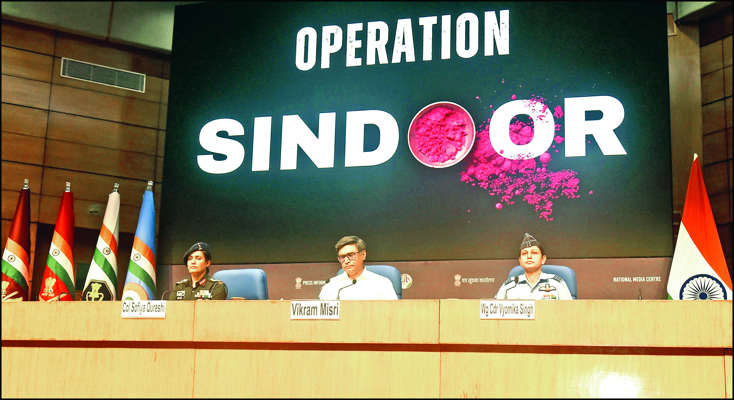
The statement was made at a media briefing by Foreign Secretary Vikram Misri, Col. Sofia Qureshi and Wing Commander Vyomika Singh after Indian armed forces carried out missile strikes on terror targets in Pakistan and Pakistan-Occupied Kashmir, including the Jaish-e-Mohammad stronghold of Bahawalpur and Lashkar-e-Taiba’s base in Muridke.
The military strikes were conducted under Operation Sindoor two weeks after the Pahalgam attack that killed 26 civilians.
Misri said the actions were measured, non-escalatory, proportionate and responsible.
Recalling the United Nations Security Council press statement on the Pahalgam attack, Misri said it underlined the “need to hold perpetrators, organisers, financiers, and sponsors of this reprehensible act of terrorism accountable and bring them to justice”.
“India’s latest action should be seen in this context,” Misri added.
The Foreign Secretary said it was deemed essential that the perpetrators and planners of the April 22 attack be brought to justice.
“Despite a fortnight having passed since the attack, there has been no demonstrable step from Pakistan to take action against the terrorist infrastructure on its territory or territory under its control. Instead all it has indulged in is denial and allegations,” he said
“Our intelligence monitoring of Pakistan-based terror modules indicated that further attacks against India were impending. There was thus a compulsion both to deter and to preempt,” Misri said.
Earlier this morning, India exercised its right to respond and preempt as well as deter more such cross-border attacks, he said.
“These actions were measured, non-escalatory, proportionate and responsible. It focussed on dismantling the terrorist infrastructure and disabling terrorists likely to be sent across to India,” he said.
From press conference
I, Col Sofyia Quereshi alongwith Wing Commander Vyomika Singh will be briefing you about the conduct of Operation SINDOOR launched by the Indian Armed Forces on the night 6th-7th May 2025 between 0105 and 0130 hours.
‘Operation SINDOOR’ was launched by Indian Armed Forces to deliver justice to the victims of the Pahalgam terror attack and their families. Nine (09) terrorist camps were targeted and successfully destroyed.
Over the last three decades Pakistan has systematically built terror infrastructure. It is a complex web of recruitment and indoctrination centres, training areas for initial and refresher courses and launch pads with handlers. These camps are located both in Pakistan and Pakistan occupied Jammu and Kashmir (POJK).
Some of the well-known training camps located in Pakistan and POJK are as shown
The selection of targets for Operation SINDOOR was based on credible intelligence inputs and role of these facilities in perpetrating terror activities. The locations were so selected to avoid damage to civilian installations and loss of civilian lives.
The target selection was done with due diligence. The camps selected for targeting and their engagement will now be shown one by one are as shown.
In POJK
(a) Sawai Nala Camp, Muzaffarabad – Located in POJK, 30 Km from on Line of Control in Tangdhar Sector, was a key LeT training facility. The attack on civilians and Security Forces in Sonmarg on 20 October 24, Gulmarg on 24 October 24 and Pahalgam attack on 22 April 25, were carried out by the terror module which had its germination at Sawai Nala.
(b) Syedna Belal Camp, Muzaffarabad – A camp of Jaish-e-Mohammad terrorist organisation, this was being used as staging area. This camp was used to train terrorists in weapons, explosives & jungle cum survival techniques for carrying out terrorist activities across Line of Control in Kashmir region.
(c) Gulpur Camp, Kotli Located 30 kilometers from the Line of Control, it was the base for LeT terrorists operating in Rajauri-Poonch. Attacks in Poonch on 20 April 2023, and Attack on innocent pilgrims travelling in a bus on 09 June 24 were conducted by terrorists trained in Gulpur. Inputs confirm that Zaki-ur-Rehman Lakhvi, the 26/11 master mind, frequently visited this camp for indoctrination and motivational speeches.
(d) Abbas Camp, Kotli – Located about 13 kilometers from Line of Control opposite Rajauri, it was known as the nerve centre for training of suicide bombers of LeT. This camp had key terrorist training infrastructure for about 50 terrorists.
(e) Barnala Camp, Bhimber Located 9 km from Line of Control opposite Rajauri – Poonch Sector was used for providing training to terrorists in weapon handling, IED making and jungle survival techniques.
In Pakistan
(f) Sarjal Camp, Sialkot – Located about six kilometers from the International Borders opposite Samba-Kathua. The terrorists who killed four personnel of Jammu and Kashmir Police in March 2025 were trained and launched from this camp.
(g) Mehmoona Joya Camp, Sialkot – located around 12 Km from International Boundary, near Sialkot, this was a key training facility of Hijbul Mujahideen. The camp was being used as the control center in revival of terrorism in Kathua and Jammu region. Major terrorist attacks including attack on Pathankot Air Force Base was planned and directed from this camp.
(h) Markaz Taiba, Muridke – Located around 25 kilometers from International Boundary, it was the Head Quarter of Lashka-e-Taiba led by Hafiz Syed Terrorists trained here have also associated with many terrorist attacks including Mumbai attacks in 2008. Azmal Kasab, the Pakistani Terrorist captured alive after Mumbai Attack had confessed of having received training at
Muridke. As per inputs, it was revealed that David Coleman Headley had also received training at this camp.
(j) Markaz Subhan, Bahawalpur Located around 100 Km from International Boundary, was the Headquarters of JeM. This camp was used for recruitment, training and indoctrinating JeM terrorists. The facility was frequently visited by the terrorist commanders including Masood Azhar who issued directions to their cadre from this camp.
Targeting
India has demonstrated considerable restraint in its response. However, Indian Armed Forces are fully prepared to respond to Pakistani misadventure, if any, to escalate the situation.
The strike on the terror camps was undertaken through precision capability, using niche technology weapons with careful selection of warheads that ensured no collateral damage. The point of impact in each of the target was a specific building or a group of buildings.
All the targets were neutralised with clinical efficiency and the results reiterate the professionalism of the Indian Armed Forces in planning and execution of operations.
No military establishments were targeted. There have been no reports of collateral damage so far.
