
Dr Jitendra addresses ‘Centre-State Conclave’, underlines India’s bioeconomy driven future growth

STATE TIMES NEWS
NEW DELHI: Union Minister Dr. Jitendra Singh called on the States to establish “BioE3 Cells” as part of India’s biotechnology revolution, with the aim of realizing Bio-Vision for Viksit Bharat by 2047.
During the “Centre-State Conclave” on BioE3 Policy held at Vigyan Bhavan here, the Minister underlined the significance of strengthening Centre-State collaboration to advance India’s bioeconomy driven future growth.
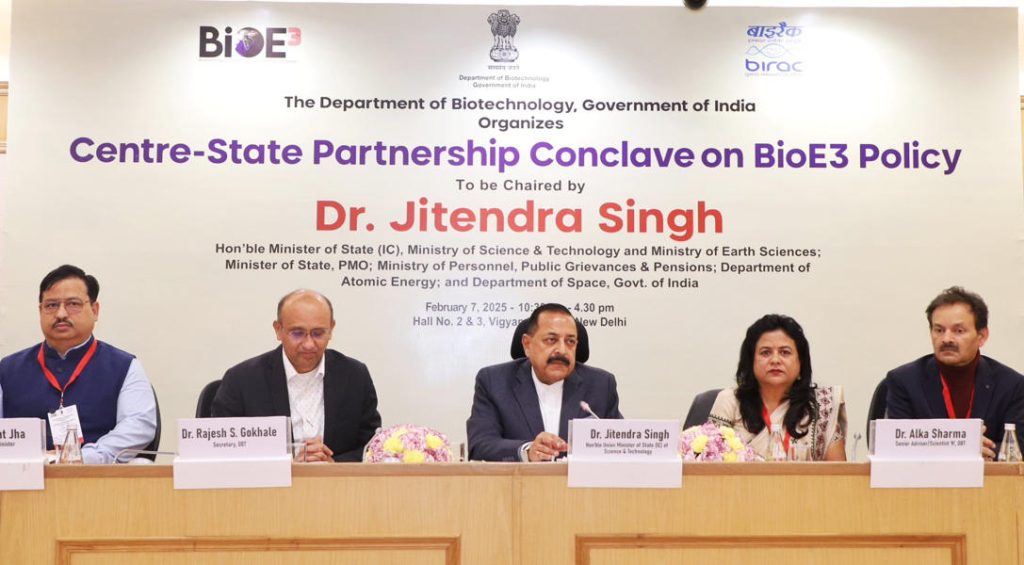
Dr Jitendra highlighted the need for state governments to leverage their unique strengths, resources, and economic priorities to propel India’s biomanufacturing sector forward. Notably, he pointed out the importance of marine resources, the Himalayan region’s resources, and other region-specific bio-resources that could help usher in a new biotech revolution.
To ensure the success of the BioE3 Policy, Dr. Jitendra Singh urged states to establish ‘BioE3 Cells’ in collaboration with the Centre through the Department of Biotechnology (DBT). These BioE3 Cells will serve as interconnected knowledge hubs, linking state and national stakeholders to facilitate the effective implementation of the BioE3 Policy. Established at the state level, these cells will act as central platforms for knowledge exchange, policy coordination, and technology adoption in the biomanufacturing sector.
On this occasion, Dr. Singh released a booklet on the Establishment of BioE3 Cells for Biomanufacturing Implementation, which aims to catalyze Centre-State partnerships to drive biotech innovations. In releasing the booklet, he highlighted that the primary goal of the BioE3 Cells is to ensure biomanufacturing initiatives are closely aligned with each state’s specific priorities, resources, and strengths, while also staying connected to broader national objectives.
He emphasized that by establishing a nationwide network of BioE3 Cells, the government aims to facilitate the integration of emerging technologies, innovative research, and sustainable biomanufacturing practices across regions, ensuring a cohesive and efficient approach to biotechnology development in India. Furthermore, Dr. Singh pointed out notable advancements in India’s biotechnology sector, including the indigenous DNA vaccine developed by the Department of Biotechnology during the pandemic, the development of the antibiotic ‘Nafithromycin’, and successful gene therapy trials at CMC Vellore. He also emphasized that India remains open to private sector collaboration, aiming to replicate the successes seen in the space sector and nuclear energy.
Highlighting the government’s commitment, Dr. Singh referred to the allocation of resources for Bio Foundries and Biomanufacturing in the latest budget, which marked a shift from typical populist priorities to a focus on science and technology under PM Modi’s leadership.
Dr. Singh also provided examples of successful Centre-State collaboration. For instance, his Department of Administrative Reforms has paired states with similar issues to address challenges effectively. He noted the central government’s funding for cleaning lakes like Loktak Lake and Dal Lake.
