
Curtail avoidable appeals to uphold CAT’s basic original mandate: Dr Jitendra

STATE TIMES NEWS
NEW DELHI: Union Minister Dr. Jitendra Singh on Saturday called upon all stakeholders to uphold and enhance the role of the Central Administrative Tribunal (CAT) in reducing the backlog of service-related cases in higher courts. Speaking at the 10th All India Conference of the Central Administrative Tribunal held at Bharat Mandapam, Dr. Singh emphasised the Tribunal’s foundational mandate to provide quick, accessible, and final adjudication of service matters, thereby easing the burden on the judiciary. Dr. Singh underlined the importance of avoiding unnecessary appeals to higher courts, noting that CAT was originally designed to ensure finality of decisions at the Tribunal level.
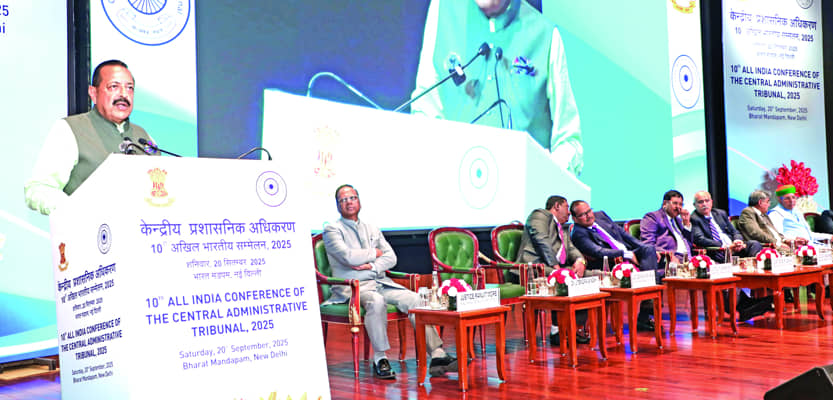
This, he said, was key to streamlining judicial procedures and delivering ease of justice to government employees. Encouraging members of the judiciary to voluntarily take up assignments in CAT, Dr. Singh pointed out that past reluctance had forced structural amendments in CAT’s functioning, such as allowing administrative members to preside over benches in the absence of judicial members. He described this as a necessary compromise, and urged the legal community to support the Tribunal system in the larger national interest. Highlighting the role of technology in judicial reform, Dr. Singh lauded initiatives like e-filing, digitisation of records, and virtual hearings, which had ensured continuity during the COVID-19 pandemic. He revealed that the government is now exploring AI-enabled case management systems to enhance the speed and consistency of judgments, while maintaining judicial independence. He further suggested that CAT could adopt performance benchmarking across its benches, using metrics such as disposal rates, pendency reduction, use of technology, and litigant satisfaction. These, he said, would promote transparency and best practices across the system. Dr. Singh also reaffirmed the government’s commitment to strengthening CAT, noting that most benches now have dedicated premises, and efforts are underway to upgrade infrastructure and increase manpower. However, he added, the integrity and dedication of Tribunal members remain the most critical element in ensuring justice delivery. In his inaugural address, Chief Justice of India, Justice B.R. Gavai, acknowledged CAT’s vital role in improving access to justice and reducing case burden on higher courts. He proposed the creation of nodal offices within government departments to pre-screen cases before pursuing appeals and encouraged the use of AI for case categorisation and multi-language translation of judgments, along with the development of a National Tribunal Database. Justice Ranjit More, Chairman of CAT, welcomed delegates and provided a detailed overview of the Tribunal’s history since the enactment of the Administrative Tribunals Act, 1985. He spoke of CAT’s expansion through permanent and circuit benches and its unique mission to deliver service jurisprudence at the doorsteps of litigants. Union Law Minister Arjun Ram Meghwal emphasised the need to reduce the cycle of repetitive appeals, stressing that digital transparency and faster case management are essential reforms.
Attorney General R. Venkataramani lauded CAT’s evolution as a credible institution, highlighting the need for quality appointments and calling for more training and workshops for Tribunal members.
The event was attended by Supreme Court Judges Justice J.K. Maheshwari, Justice Satish Chandra Sharma, Justice Prasanna B. Varale, and Justice Vijay Bishnoi, alongside High Court judges and senior government officials.
