
CSIR IIIM distributes 430 Apiculture Units under CSIR Floriculture Mission

STATE TIMES NEWS
PULWAMA: In a major outreach for strengthening the apiculture sector in the J&K UT, CSIR – Indian Institute of Integrative Medicine Jammu, distributed 430 apiculture units to 43 farmers of districts of Pulwama, Baramulla, Budgam, Shopian and Ganderbal under CSIR Floriculture Mission today at its Field Station, Bonera, Pulwama.
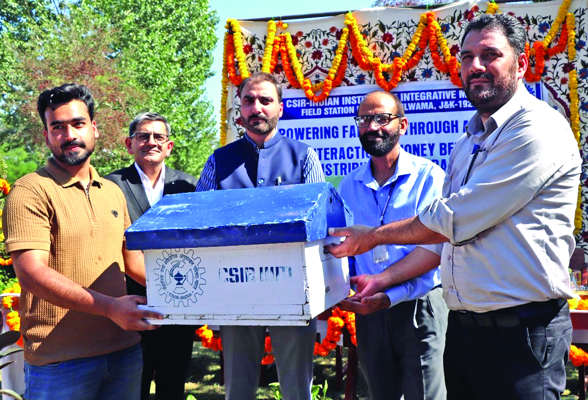
The event was organized as part of the culmination of the 10 days programme on ‘Entrepreneurship Development and Farmer Empowerment through Capacity Development’ under the CSIR Floriculture Mission.
The programme witnessed the participation of Dr Basharat Qayoom, Deputy Commissioner (DC) Pulwama; Dr Zabeer Ahmed, Director CSIR IIIM; Er Abdur Rahim, Head CSIR IIIM Branch Lab Srinagar; Dr Shahid Rasool Principal Scientist and Scientist Incharge CSIR IIIM Field Station Bonera, Pulwama; officers and researchers of CSIR IIIM and 80 farmers and agri-entrepreneurs and eminent citizens of the area.
Speaking at the event, DC highlighted the significance of initiative for rural livelihood upliftment and fostering apiculture oriented product development and their marketing. He informed that Apiculture holds immense potential in Pulwama and other parts of Kashmir owing to huge availability of varied nectar rich floral biodiversity.
The collaborative efforts of CSIR-IIIM with local farmers and agri-entrepreneurs through its multiple farm based mission programmes has strengthened the agri-oriented income generation opportunities and promoted rural bio-entrepreneurship in the region besides contributing to the sustainable economic growth in the district, he added.
Dr Basharat congratulated the Scientists of CSIR IIIM for the development of India’s first monofloral Lavender Honey thereby bringing the district on the global focus for production of the specialty honey and informed that the novelty honey will be registered for geographical indication tagging.
Director CSIR IIIM in his address highlighted the Institute’s commitment to farmer centric innovations, development and grassroots level translation of technologies. He said that through the CSIR Floriculture Mission, they are working to empower farmers by diversifying their income sources by production and utilization of commercial floriculture crops and their value added products.
“Our scientists have been actively working on diversification of farm enterprises and apiculture for its unique niche in the food value chain, which has been our priority. Beekeeping generates direct economic benefits and also improves pollination efficiency in crops, thereby enhancing overall productivity and sustainability of fragile agro-ecosystems,” he added.
Addressing the participants, Head, BLS, underlined the market prospects of quality honey and other apiculture products. He stated that adopting scientific protocols in apiculture will enable farmers to maximize income while ensuring high quality produce that meets national and international market standards.
The initiative reflects the CSIR IIIM’s broader goal of creating a holistic model for sustainable farming and rural empowerment in Jammu and Kashmir, he added.
Earlier, Prinicipal Scientist and Incharge, Field Station Pulwama presented a detailed technical overview of the CSIR Floriculture Mission, a pan India initiative for strengthening the floriculture sector through area expansion under region specific commercial floricultural crops and their effective marketing.
The programme included technical demonstrations on modern beekeeping practices, disease management in apiaries, and integration of apiculture with floriculture to enhance crop productivity and farmer income.
As part of the initiative, 430 honey bee boxes, technical manual on scientific beekeeping and certificates were distributed to 43 trained beneficiaries to support them in adopting beekeeping as a source of income and livelihood generation.
The event concluded with an interactive session between experts and
farmers.
