

Dr. Marvi Sharma
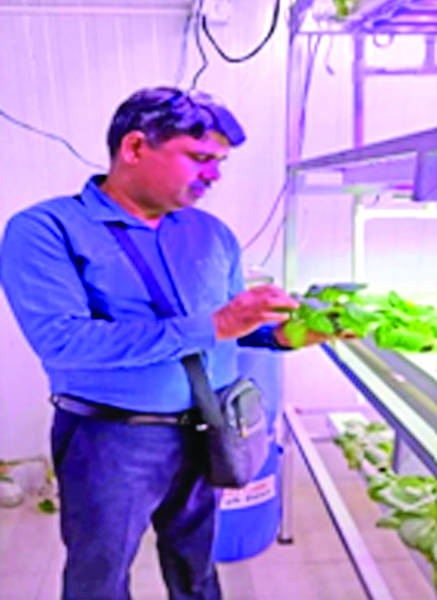
Agriculture in the Himalayan region has always been shaped by fragile ecology, limited arable land and extreme climatic conditions. In recent years, these challenges have intensified due to climate variability, irregular rainfall patterns and declining soil productivity. Among the most promising of these innovations is hydroponics, an advanced soilless cultivation system in which plants grow in nutrient-rich water under controlled conditions. The technology allows crops to be produced with significantly less land and water compared to conventional farming while ensuring better control over plant nutrition and environmental factors.
Globally, hydroponic cultivation has been practiced for decades. A central figure in this scientific initiative has been Dr. Gurdev Chand, Professor and Head of the Division of Plant Physiology at the Faculty of Basic Sciences. Since 2015, he has been leading systematic research and demonstration programmes aimed at adapting hydroponic and aeroponic technologies for local crops and climatic conditions. His research integrates plant physiological principles with controlled-environment agriculture to optimize nutrient management, improve water-use efficiency and enhance plant growth under soilless systems.
While hydroponics itself is not new globally or nationally, its structured scientific development and demonstration in Jammu and Kashmir began through organized research initiatives led by Dr. Chand and his team. Over the years, hydroponic protocols have been standardized for several vegetables, medicinal plants, aromatic crops and high-value horticultural species, enabling farmers and entrepreneurs to explore alternative models of crop production.
Because of his pioneering role in initiating sustained research, establishing experimental infrastructure and expanding the technology across the region, Dr. Gurdev Chand is widely acknowledged by scientists, students and agricultural stakeholders as the “Father of Hydroponics in Jammu and Kashmir.” His contributions have helped transform hydroponics in the Union Territory from a laboratory concept into a practical and scalable cultivation system.
One of the most significant achievements of this initiative has been the extension of hydroponic technology from the Jammu region to the Kashmir Valley. The valley experiences severe winters, where prolonged frost and sub-zero temperatures restrict natural vegetation and crop production for several months each year. During this period, farmers, particularly livestock owners face acute shortages of green fodder. To address this challenge, hydroponic systems capable of functioning in controlled environments have been introduced as a solution for producing fresh green fodder and vegetables even during harsh winter months. These systems require minimal land area, consume substantially less water and can produce fodder within a short growth cycle of about one week. As a result, hydroponic technology has emerged as a promising approach for ensuring year-round vegetation and improving fodder availability in frost-affected regions of Kashmir.
The progress achieved in hydroponic research and technology dissemination has been made possible through the collaborative efforts of a dedicated scientific community and institutional leadership. Important contributions have come from Dr. Bhav Kumar Sinha, Professor of Plant Physiology, whose expertise in plant stress physiology and nutrient dynamics has supported the experimental standardization of crops grown under hydroponic systems. Collaboration with Dr. Farooq Ahmad Khan, Professor cum scientist, Plant Physiology at Sher-e-Kashmir University of Agricultural Sciences and Technology of Kashmir, has further strengthened research coordination and technology dissemination in the Kashmir Valley, where hydroponic systems are helping address the challenge of vegetation scarcity during harsh frost winters. The recognition of Dr. Gurdev Chand as the “Father of Hydroponics in Jammu and Kashmir” has also received strong institutional support from the leadership of Sher-e-Kashmir University of Agricultural Sciences and Technology of Jammu. Dr. B. N. Tripathi, Vice-Chancellor of the university, has consistently appreciated the pioneering efforts made by Dr. Chand in introducing and expanding hydroponic and aeroponic technologies in the region. He has noted that such innovations represent an important step toward building climate-resilient agricultural systems in fragile Himalayan ecosystems and have the potential to benefit farmers, entrepreneurs and rural communities. Similarly, Dr. Sanjay Guleria, Dean of the Faculty of Basic Sciences, has acknowledged the sustained research leadership of Dr. Chand and his team in developing hydroponic production systems suited to the agro-climatic conditions of Jammu and Kashmir. He has emphasized that the work carried out under Dr. Chand’s guidance has significantly strengthened the university’s role as a centre for innovation in controlled-environment agriculture and has contributed to the wider recognition of Dr. Chand’s pioneering contributions to soilless farming in the region. The initiative has also been supported by a team of young researchers and professionals engaged in system installation, experimental trials and technology documentation. Among them, Dr.Marvi Sharma has been actively involved in research support, training programmes and the documentation of hydroponic and aeroponictechnologies, helping facilitate the transfer of knowledge from laboratories to farmers and field-level demonstrations.Beyond academic research, these initiatives have focused strongly on capacity building and technology outreach. Over the years, several training programmes, workshops and demonstration activities on hydroponics, aeroponics and vertical farming have been organized for farmers, students and aspiring agri-entrepreneurs. These programmes have helped build awareness about controlled-environment agriculture and encouraged the adoption of innovative farming systems capable of producing high-value crops with limited resources.
The expanding scope of hydroponic research has also opened new opportunities in high-value horticulture. Recently, a project worth Rs. 314.25 lakhs focusing on blueberry cultivation in the Jammu region was approved by National Bank for Agriculture and Rural Development under the technical leadership of Dr.Gurdev Chand. The project aims to introduce and scale up blueberry production using modern cultivation technologies, creating new economic opportunities for farmers and agri-entrepreneurs.
The growing recognition of Dr. Gurdev Chand as the “Father of Hydroponics in Jammu and Kashmir” ultimately reflects not only his individual contributions but also the broader success of a scientific movement aimed at building a more resilient and sustainable agricultural future for the Himalayan region. As hydroponic systems continue to reach farmers, institutions and entrepreneurs, they offer renewed hope that innovation and science can help secure both food production and rural livelihoods in one of the most challenging agricultural landscapes of the country.
