
Floriculture Sector in J&K seeks policy push, focused government intervention

STATE TIMES NEWS
JAMMU: Floriculture in Jammu and Kashmir stands at a crucial juncture in the evolving agrarian landscape, with flower growers demanding focused government attention to address long-pending issues affecting the sustainability and growth of the sector. Flower growers from various parts of the Union Territory assembled here today to deliberate on the current status and future prospects of commercial floriculture in J&K.
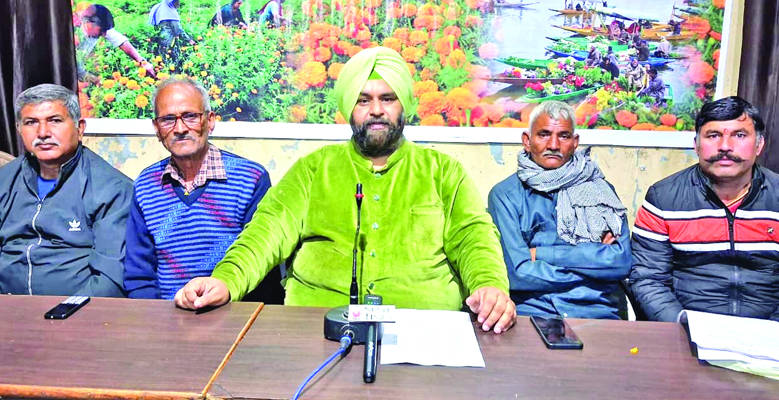
Addressing the gathering, Tejinder Singh Wazir, Member, J&K Kissan Advisory Board, said floriculture is a billion-dollar global industry driven by nursery production, cut flowers, and loose flowers used extensively for devotional and cultural purposes.
He stated that despite the floriculture industry in Jammu and Kashmir being valued at nearly Rs 500 crore, it continues to remain under-privileged in planning, budgeting, and implementation by the UT administration.
Referring to official budget figures, Wazir observed that floriculture in the UT remains largely disorganised. He expressed concern that even during the ongoing budget session, flowers were imported from other parts of the country by the concerned department, contradicting the government’s slogan of “Vocal for Local.” He stressed that the sector requires structured planning and sustained policy support to realise its true potential.
Highlighting Kashmir’s natural advantage, Wazir said the UT remains dependent on the import of tulips and trillions of flower bulbs every year, despite ICAR and CSIR reports identifying Kashmir as a key destination for flower bulb production in India. He lamented that floriculture continues to be viewed largely as an aesthetic activity rather than a viable livelihood option, calling this approach detrimental to the sector’s long-term sustainability.
Wazir advocated UT-level interventions, including a blanket ban on the import of flower bulbs for the public sector, and suggested the development of theme-based gardens such as guldaudi, lupins and bougainvillea with the active involvement of local growers.
While major agriculture-related projects like MIDH, HADP and JKCIP are being implemented in the UT, Wazir pointed out that these schemes are handled by multiple departments under the Agriculture Production Department, leading to confusion, overlap and poor coordination. He said floriculture components under these schemes remain weak, with gaps in quality planting material, protected cultivation, post-harvest management and market linkages.
Emphasising sustainability, he called for interest subvention, revival of sick units, timely supply of quality planting material, and creation of dedicated marketing infrastructure. He said a modest budgetary allocation of ?50 crore could significantly transform the sector.
The farmers welcomed top-up subsidies for micro and sprinkler irrigation worth Rs 116.86 crore, but demanded a dedicated Floriculture Mission, insurance cover and enhanced subsidies. Referring to the CSIR Floriculture Mission under the leadership of Dr Jitendra Singh, Wazir noted that mission-mode scientific interventions have proven effective.
Calling for corrective measures, Wazir urged the organisation of Pushp Kranti Melas in Jammu and Posh Inqilab Melas in Kashmir to bring together growers, scientists and buyers. The growers appealed to Dr Jitendra Singh, Union Minister for Science and Technology, Chief Minister Omar Abdullah, and Javid Ahmed Dar, Minister for Agriculture Production, to initiate coordinated and time-bound interventions to revive commercial floriculture in Jammu and Kashmir.
