

STATE TIMES NEWS
- Govt blends development with dignity, growth with social justice
- J&K recorded 1.78 crore tourist visits in 2025 despite security incidents, natural calamities
- Transition to popular governance in the UT has reinforced public faith in democratic institutions and restored participatory governance
JAMMU: Lieutenant Governor Manoj Sinha on Monday said the economy of Jammu and Kashmir has demonstrated encouraging momentum in recent years, with the Union Territory recording an annual nominal growth rate of around 11 per cent in 2024-25.
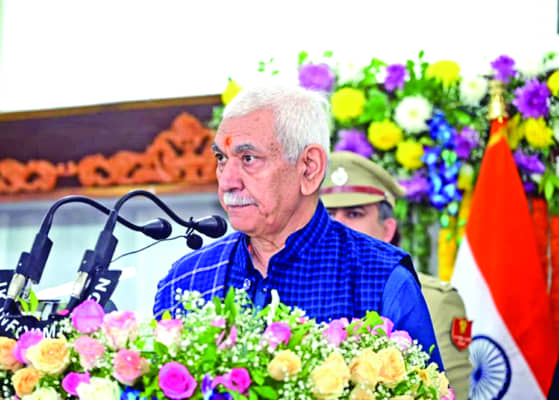
He said that the growth reflects positive outcomes of sustained policy reforms, enhanced infrastructure development and proactive investment facilitation.
“The economy of J&K has demonstrated encouraging momentum in recent years. The Union Territory recorded an annual nominal growth rate of around 11 per cent (2024-25), reflecting the positive outcomes of sustained policy reforms, enhanced infrastructure development, and proactive investment facilitation,” Sinha said while addressing members of Legislative Assembly here at the start of the budget session.
Sinha said the government remains committed to consolidating this growth trajectory through strengthened fiscal discipline and creating diversified and sustainable employment opportunities, with particular emphasis on youth and women.
The Lieutenant Governor said Jammu and Kashmir has emerged as one of the fastest-growing Union Territories in the country, with GST revenue collections increasing from Rs 8,064 crore in 2023-24 to Rs 8,586 crore in 2024-25.
He added that tariff from electric power witnessed a substantial increase of 16 per cent during 2024-25. Highlighting financial assistance, Sinha said the Special Assistance to States for Capital Infusion (SASCI), which provides interest-free loans for capital investments, has been extended to J&K from the current financial year.
He said Rs 1,431 crore has been sanctioned under SASCI for 222 projects, along with Rs 210 crore as matching share for 12 centrally-sponsored schemes.
“The first instalment of Rs 1,083 crore, accounting for 66 per cent of the sanctioned amount, has already been received,” he said.
The Lieutenant Governor said that digital governance has seen significant progress, with the Union Territory recording 82 crore e-transactions during the previous year, averaging over 22 lakh transactions per day.
He said 128 services have been integrated with DigiLocker, while complete Aadhaar seeding of welfare beneficiaries has enabled seamless Direct Benefit Transfer (DBT).
He said that around Rs 9,000 crore has been credited directly to the accounts of 80 lakh beneficiaries through 77 DBT-based schemes during the current financial year.
Sinha added that the government is also formulating a comprehensive Artificial Intelligence strategy to drive innovation and efficiency across priority sectors, including healthcare, agriculture, mobility, education and law enforcement.
Referring to governance reforms, Sinha said the government has laid renewed emphasis on responsive and people-centric administration.
He said regular public grievance redressal meetings at the Chief Minister’s Outreach Office and the strengthening of the JK Samadhan portal have helped resolve thousands of grievances through time-bound interventions.
The Lieutenant Governor also said Jammu and Kashmir Bank has undertaken various reforms with the support of the UT government, including professionalisation of management, merit-based selection of top posts and capital infusion.
He said these measures have resulted in a turnaround of the bank, improving its net non-performing assets and capital adequacy. Highlighting infrastructure development, Sinha said that the road sector has witnessed unprecedented investment of Rs 61,528 crore, covering expressways, national highways, ring roads and tunnels to enhance regional and inter-regional connectivity.
He said that three major tunnels, including the Sonamarg Tunnel, have been completed, while eight others, including the strategic Zojila Tunnel, are at advanced stages of completion.
The Narbal-Shopian-Surankote road has also been declared a National Highway, further strengthening all-weather connectivity across the Pir Panjal region, he added.
The Lieutenant Governor said transition to popular governance in the Union Territory has reinforced public faith in democratic institutions and restored participatory governance.
He said the government remains focused on tackling unemployment, bridging infrastructure gaps and expanding social welfare measures with renewed energy and determination.
“The government during its first year in office has sought to combine development with dignity, growth with social justice, and progress with peace. Guided by the vision of inclusive governance, it remains committed to addressing the challenges of unemployment, infrastructure gaps, and social welfare with renewed energy and determination”, he said.
Sinha said the government has adopted a humane and compassionate approach in dealing with issues concerning common citizens, including employees, daily wagers, contractual workers and marginalised sections, adding decisions affecting them have been examined with empathy and corrective steps initiated wherever required.
He said good governance continues to remain the cornerstone of the government’s development strategy, with sustained reforms in transparency, accountability and citizen-centric service delivery strengthening public trust and institutional efficiency. “Over 1,500 public services have been made available online and 391 services integrated with the auto-appeal system to ensure timely delivery”, he added.
Describing the formation of an elected government after a gap of several years as a significant milestone, Sinha said the transition to popular governance has reinforced public faith in democratic institutions and restored participatory governance.
“The government remains committed to timely conduct of local body elections and deeper integration of digital governance to enhance transparency and accountability”.
The Lieutenant Governor said employment generation and youth empowerment remain central to the government’s development vision.
“As many as 7,650 government posts were filled in 2025 through transparent and merit-based recruitment, while the recruitment process for 23,800 additional posts is underway. Besides, 910 compassionate appointments were made, including 464 to the next of kin of terror-affected families”, he said.
Highlighting Mission YUVA, Sinha said the initiative aims to establish 1.35 lakh entrepreneurial units and generate employment opportunities for 4.5 lakh youth.
He said more than 1.51 lakh youth have registered under the programme, with over 61,900 applying under credit-linked schemes and more than 12,000 cases sanctioned involving loans exceeding Rs 800 crore.
The LG said social welfare remains a key priority, adding that under the National Food Security Act, ration support is being provided to 25 lakh families, while 16.62 lakh households are receiving free ration under the Pradhan Mantri Garib Kalyan Anna Yojana.
He said financial assistance is being extended to over 10 lakh beneficiaries under social security schemes, with enhanced monthly pensions ranging from Rs 1,250 to Rs 2,000 depending on age categories.
The government has also rationalised eligibility conditions under the Marriage Assistance Scheme to expand its coverage, he added.
On urban development, the LG said 277 projects have been completed under the Smart City Mission, while 90 projects under AMRUT-II have been approved at a cost of over Rs 1,000 crore, aimed at improving sanitation, water supply and rejuvenation of water bodies.
Sinha said housing and rehabilitation remain priority areas, with 3.21 lakh houses constructed under the Pradhan Mantri Awas Yojana (Gramin) and land being provided to landless beneficiaries. He said the government is also providing five marlas of land to families who lost residential land due to natural calamities.
Highlighting industrial growth, the LG said 2,227 industrial units with investments worth Rs 15,940 crore have commenced production since 2020, generating employment for over 73,800 persons. Another 1,028 units with proposed investment of Rs 27,613 crore are under implementation, he added.
He said 1,316 start ups, including 471 women-led enterprises, have been registered under the Start up India initiative, while 6,050 self-employment enterprises have been established under the Prime Minister’s Employment Generation Programme.
Sinha said the handloom and handicrafts sector continues to provide livelihood to nearly 4.45 lakh people, with 18 handicraft products receiving Geographical Indication tagging and 17 more under registration.
He said Jammu and Kashmir has secured the fifth rank nationally under the Business Reform Action Plan.
He also highlighted progress in agriculture and allied sectors, stating that milk production has reached 28.75 lakh metric tonnes, while mutton and wool production have registered significant growth. He said crop diversification, seed ecosystem strengthening and expansion of oilseed cultivation and honey production have boosted farmers’ incomes.
Calling for collective efforts, the LG urged members of the House to work in a spirit of cooperation and shared responsibility to build a peaceful, progressive and prosperous Jammu and Kashmir ensuring dignity, opportunity and hope for every citizen.
Observing that tourism continues to be a vital pillar of Jammu and Kashmir’s economy, he said the Union Territory recorded 1.78 crore tourist visits in 2025 despite security-related incidents and natural calamities.
“Despite challenges arising from security-related incidents and natural calamities, the Union Territory recorded 1.78 crore tourist visits in 2025,” Sinha said.
The Lieutenant Governor referenced security incidents and natural calamities, including the Pahalgam attack, Operation Sindoor, and last year’s floods.
Sinha noted that tourism has been accorded industry status to attract investment and generate employment in the region. He highlighted the opening of the first-ever Chrysanthemum Garden, Bagh-e-Gul-e Dawood, for tourists in October 2025, which aims to promote Kashmir as a year-round destination.
“With more than 50 vibrant varieties, the garden is a strategic cornerstone in our mission to transition Kashmir into a year-round destination. Just as the tulip garden defines our spring, Bagh-e-Gul-e Dawood is set to become the definitive icon of autumn and will attract tourists during the lean season,” he said.
Sinha further shared that the government has undertaken confidence-building measures, improved tourist facilitation and strengthened coordination with stakeholders to boost the sector.
“Special focus has been laid on reviving pilgrim tourism in Jammu, adventure tourism in Kashmir and eco-tourism in tribal and border areas to ensure balanced regional growth,” he added.
He noted that the government is planning to launch a significant project for the sustainable development of emerging tourist destinations through public and private sector investments to expand the tourism footprint across the Union Territory.
Highlighting achievements in the power sector, Sinha said it has witnessed a structural transformation, with major hydropower projects, including Pakal Dul, Kiru, Kwar and Ratle, having a combined capacity of 3,014 MW, under execution.
He said that in the last five years, 5,708 MVA capacity has been added to the distribution sector and 4,239 MVA to the transmission sector. “Installation of smart prepaid meters is underway in mission mode, with 10.44 lakh meters already installed and 100 per cent coverage targeted by 2026-27,” he said.
The Lieutenant Governor mentioned that power losses have reduced by nine per cent, while revenue realisation has increased by 16 per cent. He added that solarisation of government buildings and households under the PM Surya Ghar Muft Bijli Yojana has further strengthened renewable energy adoption, with over 6,700 government buildings and more than 16,800 households already solarised.
Sinha also described the railway connectivity to Kashmir as a historic milestone, saying that the Valley has now been linked with the rest of the country, opening new avenues for trade, tourism and economic progress.
He informed that a full-fledged railway division has been sanctioned for Jammu and Kashmir, and expansion and modernisation of the Jammu Tawi railway station is underway.
Emphasising infrastructure development, the lieutenant governor said the road sector has witnessed unprecedented investment of Rs 61,528 crore, including expressways, national highways, ring roads and tunnels, significantly improving connectivity.
He reported the completion of three major tunnels, including the Sonamarg Tunnel, while eight others, including the critical Zojila Tunnel, are at advanced stages of completion. Additionally, the Narbal-Shopian-Surankote road has been declared a National Highway to strengthen all-weather connectivity across the Pir Panjal region, he said.
Sinha said that 19 new National Highway projects worth Rs 10,637 crore have been sanctioned for 2025-26, including key works such as the Pir Ki Gali Tunnel, Sadhna Tunnel, Lal Chowk-Parimpora Flyover and Magam Flyover, aimed at easing traffic congestion and improving urban mobility.
KEY HIGHLIGHTS
- Lieutenant Governor described the formation of an elected government after several years as a major democratic milestone, strengthening public faith in democratic institutions.
- Development in J&K is being guided by the principles of Economy, Ecology, and Equity, ensuring inclusive and environmentally sustainable growth.
- Good governance and digital reforms remain central, with over 1,500 services online, 391 auto-appeal services, and 82 crore e-transactions recorded in the past year.
- Rs 9,000 crore transferred directly to 80 lakh beneficiaries under DBT through 77 welfare schemes after complete Aadhaar seeding.
- J&K economy recorded around 11% nominal growth (2024–25); GST revenue rose to Rs 8,586 crore, while power tariff revenue increased by 16%.
- Under Special Assistance to States for Capital Infusion, Rs 1,431 crore sanctioned for 222 projects; Rs 1,083 crore already released.
- Jammu & Kashmir Bank reforms led to reduced NPAs and improved capital adequacy.
- Massive infrastructure push with Rs 61,528 crore invested in roads, highways, tunnels, and expressways.
- Completion of Sonamarg Tunnel, progress on Zojila Tunnel, and sanctioning of 19 new NH projects worth Rs 10,637 crore.
- Rail connectivity to Kashmir Valley achieved, full-fledged Railway Division sanctioned, and modernization of Jammu Tawi station underway.
- First-ever FCI freight train to Kashmir operational, improving logistics and reducing pressure on NH-44.
- Power sector transformation with 3,014 MW hydropower projects, smart meters (10.44 lakh installed), reduced losses, and expanded solarisation.
- Approval for 200 free electricity units to 2.23 lakh AAY families under PM Surya Ghar Muft Bijli Yojana.
- Significant progress under Jal Jeevan Mission, with majority rural households receiving tap water connections.
- Tourism recorded 1.78 crore tourist visits in 2025; tourism granted industry status.
- Opening of Chrysanthemum Garden “Bagh-e-Gul-e-Dawood” to promote year-round tourism.
- Push for sustainable tourism, homestays, border and rural tourism with public-private participation.
- Promotion of sports tourism through Kashmir Marathon, upcoming Jammu Marathon (March 2026), and winter sports events.
- Agriculture revitalized under HADP, crop diversification, e-NAM integration, CA storage expansion, and GI tagging of local products.
- Sharp rise in honey, oilseed, fish, dairy, mutton, and wool production.
- Implementation of PM Fasal Bima Yojana across all 20 districts.
- Expansion of healthcare infrastructure with AIIMS Jammu, upcoming AIIMS Kashmir, new medical seats, cath labs, critical care blocks, and SEHAT App.
- Education reforms include NEP implementation, smart classrooms, ATAL Tinkering Labs, ICT labs, PM-SHRI schools, and A++ NAAC accreditation for J&K universities.
- Urban development boosted through Smart City Mission, AMRUT-II, and Swachh Bharat Mission 2.0.
- Over 3.21 lakh houses constructed under PMAY-Gramin; five marla land scheme for disaster-affected families.
- Industrial growth with 2,227 units operational, 1,028 more under implementation, and over 73,800 jobs generated.
- Growth in startups, PMEGP self-employment, and strong support to handloom and handicrafts sector.
- Expansion of social welfare, pensions enhanced, free ration under NFSA and PMGKAY, and additional ration for AAY families.
- Focus on women empowerment through Lakhpati Didi initiative and free public transport for women.
- Major reforms for tribal welfare, including transfer of Forest Rights Act implementation to Tribal Affairs Department.
- Mission YUVA launched to promote entrepreneurship, aiming to create 1.35 lakh enterprises and jobs for 4.5 lakh youth.
- Transparent recruitment with 7,650 posts filled and recruitment underway for 23,800 more posts.
- 910 compassionate appointments, including 464 for terror-affected families.
- LG called for unity, cooperation, and shared responsibility to build a peaceful, progressive, and prosperous Jammu and Kashmir.
