

NEW DELHI: Union Minister Jitendra Singh on Wednesday said the Union Public Service Commission (UPSC) has lived up to the responsibility of being the guardian of the country’s steel frame of governance.
Addressing an event here, he said the UPSC has stood as a pillar of integrity, fairness, and transparency through India’s pre- and post-Independence eras, serving as a silent witness to the nation’s democratic journey.
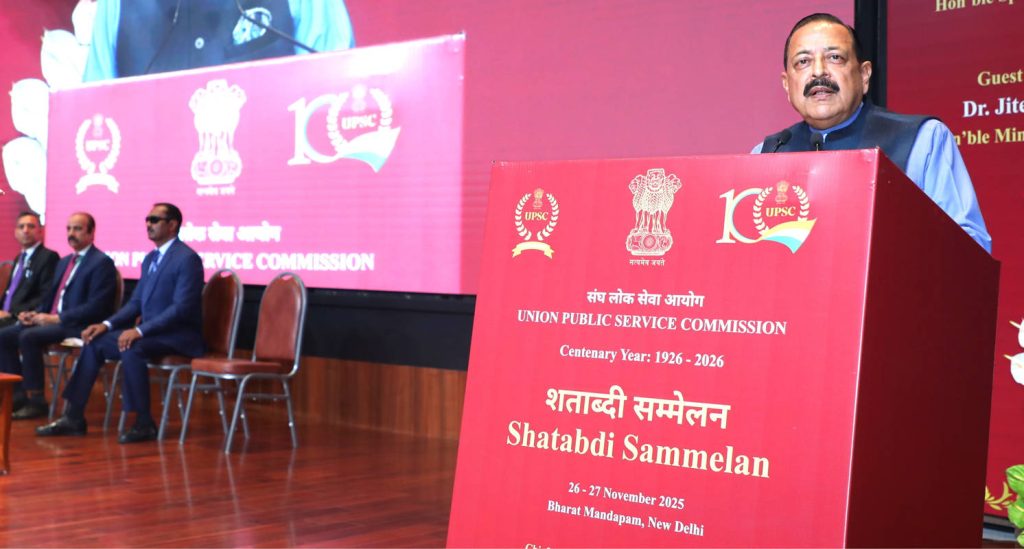
He recalled Sardar Vallabhbhai Patel’s description of the civil services as the “steel frame of India” and said, “It is the Union Public Service Commission that has lived up to the responsibility of being the guardian of this steel frame.”
Singh, the Minister of State for Personnel, hailed the UPSC as the “guardian of India’s steel frame of governance”.
The minister was addressing the inaugural session of the ‘Shatabdi Sammelan’ (centenary conclave), the centenary celebration of UPSC, at Bharat Mandapam here.
The commission conducts the civil services examinations, among others, to select the country’s bureaucrats, diplomats, and police officers among others.
Singh commended UPSC’s ‘Pratibha Setu’ portal, which seeks to create new opportunities for candidates who have cleared the civil services examination stages but did not make it to the final selection, by connecting them with private sector and institutional openings.
He termed the move “an innovative bridge between talent and opportunity,” ensuring that India’s intellectual potential is not lost but leveraged for national development.
The minister also emphasised UPSC’s larger role beyond recruitment, framing and updating service rules, reviewing administrative practices, and setting ethical standards for public service.
He expressed satisfaction that despite emerging challenges and debates around Constitutional institutions, UPSC continues to uphold “the highest traditions of India’s constitutional values, meritocracy, and fairness”, according to an official statement.
Singh said the architects of “Viksit Bharat @ 2047” will emerge from this very institution that has trained generations of India’s finest civil servants.
The two-day ‘Shatabdi Sammelan’ being organised by the UPSC on November 26-27, marks a monumental milestone in the Commission’s 100-year journey of nation-building.
The event brings together present and former chairpersons and members of UPSC and State Public Service Commissions (PSCs), along with senior officials from across the government of India, scholars, and distinguished personalities associated with governance and public administration.
Delivering the welcome address, UPSC chairman Ajay Kumar said the commission re-dedicates itself to the ideals of fairness, meritocracy, and equity in our recruitment, examination, and promotion systems.
He also acknowledged the presence of former chairpersons and members of the commission, calling them “luminaries who set the high bar for succeeding generations,” and emphasised the strong institutional bond between UPSC and State Public Service Commissions across India.
“The UPSC will always remain the sacred temple of trust and integrity envisioned by the framers of our Constitution,” he said.
In his keynote address, Lok Sabha Speaker Om Birla extended heartfelt greetings on UPSC’s centenary and Constitution Day, calling the commission “one of the most important institutions in India’s democratic and administrative framework”.
He said that in its 100-year journey, UPSC has embodied transparency, impartiality, confidentiality, and accountability, setting benchmarks not just for India but for governance systems worldwide.
Birla observed that the Constituent Assembly, recognising the need for independence and neutrality in public recruitment, enshrined UPSC’s autonomy in the Constitution, a principle the commission has upheld with exemplary integrity.
He lauded the institution’s ability to adapt to changing times, citing reforms in examination systems, promotion methods, and digital adoption as examples of its progressive spirit.
Highlighting the inclusive nature of UPSC’s processes, the Speaker said, “Candidates from every region, language, and socio-economic background participate in this examination with complete faith in its fairness. That trust is the greatest testimony to UPSC’s credibility”.
Addressing future challenges, Birla urged the commission to continue evolving with emerging global realities such as artificial intelligence, climate change, cybersecurity, and national security.
“The leadership emerging from this institution has guided India’s executive system with sensitivity, ethics, and commitment to public service. As UPSC enters its second century, it will continue to play a defining role in shaping the future of governance in India,” Birla said. (PTI)
