
Modi Govt removed barriers between public, private sectors, enabling healthy synergy: Dr Jitendra

STATE TIMES NEWS
NEW DELHI: “The Modi Government has removed unreasonable barriers between public and private sectors, enabling a healthy synergy of best practices from all domains to be harnessed”.
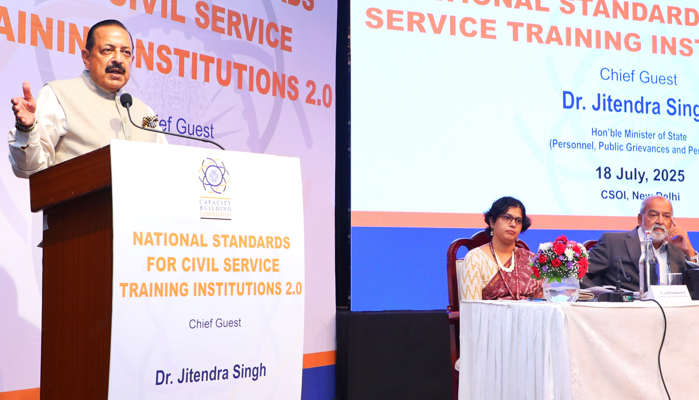
This was stated here on Friday by Union Minister of State (Independent Charge) for Science & Technology, Dr. Jitendra Singh while launching the “National Standards for Civil Service Training Institutes 2.0” (NSCSTI 2.0) at the Civil Services Officers Institute (CSOI), here. Developed by the Capacity Building Commission (CBC), the revamped framework marks a major leap in India’s mission to build a future-ready civil service.
Dr. Jitendra Singh said, “This milestone has been made possible because Prime Minister Narendra Modi has always encouraged out-of-the-box thinking and empowered us to break taboos of the past. NSCSTI 2.0 is not just a compliance tool-it is a transformative step toward institutional excellence.”
The Minister highlighted how the framework supports cooperative and competitive federalism, empowering institutes to evaluate and upgrade themselves. “Just as the Aspirational Districts Programme enabled backward districts to outshine expectations, NSCSTI 2.0 encourages CSTIs to introspect, innovate and pursue excellence,” he noted.
The upgraded NSCSTI 2.0 framework presents a more refined, inclusive, and future-ready approach to civil services training. It has been simplified and streamlined, with the number of evaluation metrics rationalized from 59 to 43, ensuring greater clarity and a sharper focus on outcome-based assessments.
The framework is field-informed, drawing extensively from consultations with over 160 Civil Service Training Institutes (CSTIs), assessors, and domain experts, making it grounded in real-world training challenges and needs. Its inclusive design makes it adaptable for training institutes across all levels of government-Central, State, and Urban Local Bodies (ULBs).
Recognizing the shifting learning landscape, the framework is also digitally aligned, embracing hybrid learning models and AI-driven training mechanisms. Most importantly, it is forward-looking, integrating progressive elements such as Indian Knowledge Systems (IKS), the Karmayogi Competency Model (KCM), and the Amrit Gyaan Kosh (AGK), thereby aligning with India’s vision of building a future-ready, competent, and citizen-centric civil service.
Dr. Jitendra added, “The Modi Government has removed unreasonable barriers separating public and private sectors, enabling the best practices from all domains to be harnessed. This framework is an outcome of that vision.” He emphasized the need for extending customized training modules to scientific institutions, stressing the importance of administrative preparedness in addition to technical expertise.
Recounting the global interest in India’s civil services reform model, Dr. Jitendra shared that countries like Bangladesh, South Africa, and Maldives have shown keen interest in studying Mission Karmayogi. “This is a testament to India’s leadership in governance reform,” he said.
In just two years, over 195 CSTIs have already been accredited under NSCSTI. The upgraded version builds on real-time feedback and CBC’s principle of participatory governance.
The event was attended by Adil Zainulbhai, Chairperson, Capacity Building Commission; Dr. R. Balasubramaniam, Member (HR); Dr. Alka Mittal, Member (Admn); V. Lalithalakshmi, CEO, Karmayogi Bharat; Syama Prasad Roy, Joint Secretary, CBC and other senior officials. Faculty members from Administrative Training Institutes (ATIs) and Central Training Institutes (CTIs) also participated.
