

VIVEK SHARMA
JAMMU: In the wake of the unprecedented tensions following the near war-like situation between India and Pakistan on May 7, 2025, an important interaction under the theme “Preparedness: Citizens of Jammu” was held on Wednesday at Scottish Hall, Alexander Memorial School, Jammu.
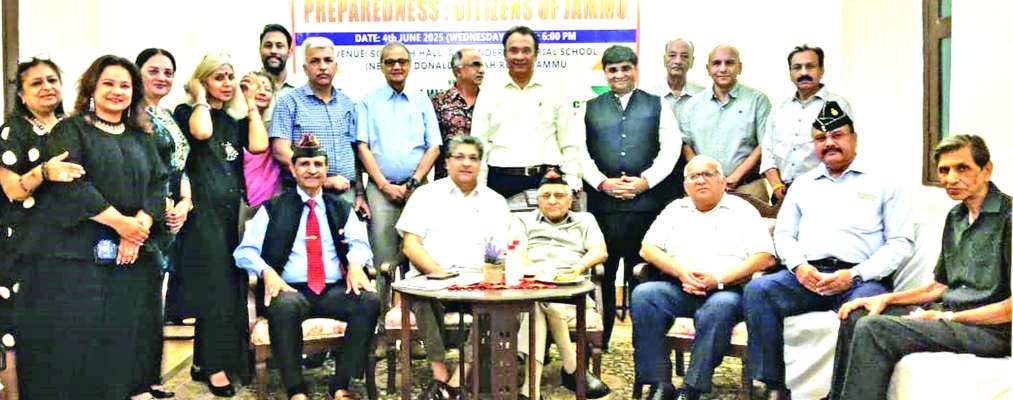
The gathering brought together retired defence officers, senior bureaucrats, academic scholars, journalists and senior civil society members and the power-packed forum to discuss citizen preparedness, response to emergencies, and the importance of public awareness in times of national security crises.
The interaction was hosted and moderated by Johnny William, IPS (Retd.), former Inspector General of Police, a respected voice in matters of internal security and community engagement.
The session commenced with a brief description of incidents in honour of all martyrs and victims of cross-border hostility and the session moved into a deeply engaging discussion.
Lt. Gen. (Retd.) R.K. Sharma spoke on how India taught Pakistan a lesson. Opening the session, Lt. Gen. R.K. Sharma (Retd.) delivered a powerful keynote address, providing a strategic overview of the May 7 incident, and the swift, calibrated military response by India.
“This was not just a show of strength-it was a message of deterrence and unity. Our nation stood tall, our armed forces were vigilant, and our leadership firm. Pakistan miscalculated, and our retaliation conveyed a clear lesson: India will defend its soil and citizens with full might,” he said.
He also highlighted the importance of citizen morale, emphasizing that preparedness is not limited to borders but begins in homes, schools, and public institutions.
Former Chief Secretary, J&K B.R. Sharma, IAS spoke on governance is the backbone in crisis and wars. He brought an administrative perspective, outlining how government departments are aligning efforts to manage public safety, logistics, and information dissemination.
“The government has already initiated public outreach programmes, mock drills, and awareness drives in collaboration with civil defence and disaster management teams,” he noted. “We are also working to bridge gaps in rural preparedness and bringing local bodies on board.”
He emphasized the role of local governance, schools, and religious leaders in educating the masses without triggering panic.
Former IAS officer Ashok Angurana described communication and compliance are crucial. Bringing in years of bureaucratic experience, Ashok Angurana, IAS (Retd.), stressed the urgency of structured communication systems during crises.
“Compliance with guidelines-especially related to curfews, movement restrictions, and blackouts-cannot be left to individual interpretation. Clear, repeated, and credible messaging is key,” he said.
Prof. Sapna Sangra from Department of Sociology educated the gathering to counter panic. One of the most moving and academically sound interventions came from Prof. Sapna Sangra.
“Panic is more contagious than any virus. In war-like situations, it is preparedness through education that acts as a stabilizer,” she remarked.
A well-known sociologist from Jammu University Prof. Sangra proposed the inclusion of basic disaster literacy in school curricula, and community-based training workshops to empower youth, homemakers and senior citizens.
Raj Kumar Aima, Deputy Director, Fire & Emergency Services impressed upon all for installing fire extinguishers and train everyone.
From a crisis-response lens, Raj Kumar Aima, Deputy Director, Fire and Emergency Services, gave a practical examples of fire safety protocols. “Be it a blackout, an air raid, or even a rumour-induced stampede, fire hazards multiply during panic. Every home, office, school, and religious place must have functional extinguishers, and more importantly, trained hands to use them.”
ICC Jammu Business Council Chairman Rahul Sahai suggested why blackouts matter and how to follow protocols. In a practical and public-centric talk, Rahul Sahai addressed a question on many minds: Why are blackouts and drills important. ?
Enemy drones and aircraft if not depend on lights and heat signatures to locate targets, then why blackouts. Cooperation with government protocols is not a favour; it’s a national duty,” he explained. He called for awareness sessions in residential colonies and mock blackout rehearsals to ensure readiness without chaos.
Maj. Gen. Goverdhan Singh Jamwal (Retd.) spoke on welfare of families is mission critical. He emphasized the importance of community-level support networks.
Defense Expert Brig Diman, whose book on Pahalgam is in printing phase, also gave impressive speech, describing Indian Army and how we are capable to handle all situations.
Rohini Aima, Principal of Jammu Sanskriti School, discussed how schools can be proactive in emergency preparedness, She spoke from the heart, highlighting the psychological toll of conflict on young minds.
“Children absorb more than we realize. Let’s not hush things up but talk to them gently, truthfully, and responsibly. Let’s make school counsellors a part of the preparedness chain.”
She recommended storytelling, posters, and role-plays in classrooms as tools for instilling calm and confidence in children.
The event concluded with remarks from the moderator Johnny William, who thanked all participants and the Scottish Hall management for facilitating the dialogue.
“Security is a shared responsibility. While the armed forces protect the borders, we, the citizens, must fortify the inner fabric of resilience, preparedness, and awareness,” he said.
He promised to continue such engagements and proposed the formation of a Citizen Emergency Forum to coordinate community efforts in the coming months.
The session served as a reminder that resilience begins at home-informed, alert, and united citizens are our strongest shield against any external threat.
Prominent among others who participated in the function include Editor-in-Chief STATE TIMES Raj Daluja, Advocate Sheikh Shakeel, DIG (retired) Rajinder Gupta, Brig Swaran Singh, Mamta Wahi, Sanjay Wahi, Ex-Chief Engineer Lalit Kumar, Karan Singh, Chairman, J&K Transport Union, Sidharth from Jammu Links and galaxy of civil society members.
